Website Redesign Agency vs. Freelancer vs. Subscription
The decision people usually think they’re making is whether to redesign their website at all. By the time they’re comparing agencies, freelancers, and subscriptions, they’ve already made that call, and the real question is who actually does the work.
Every option comes with a different mix of cost, speed, and risk, and none of them is universally right. This post breaks down what each one actually costs, what you get for it, and where the real risk sits, so you can match the option to your budget and your project instead of guessing.
Key Takeaways: Agencies cost the most, typically $5,000 to $25,000 or more, but spread risk across a team instead of one person. Freelancers cost less, usually $500 to $5,000, but the whole project rests on a single person staying available. Subscriptions trade a big upfront cost for an ongoing flat fee, but the tier matters enormously: most local businesses only need a small-business-tier plan, not the $549-plus-a-month tier built for funded startups. There’s no universally right answer, only a right fit for your budget, timeline, and how much ongoing work you’ll need after launch.
If you haven’t nailed down whether you actually need a redesign yet, back up to the complete guide to website redesigns for small businesses first.
What Each Model Actually Costs
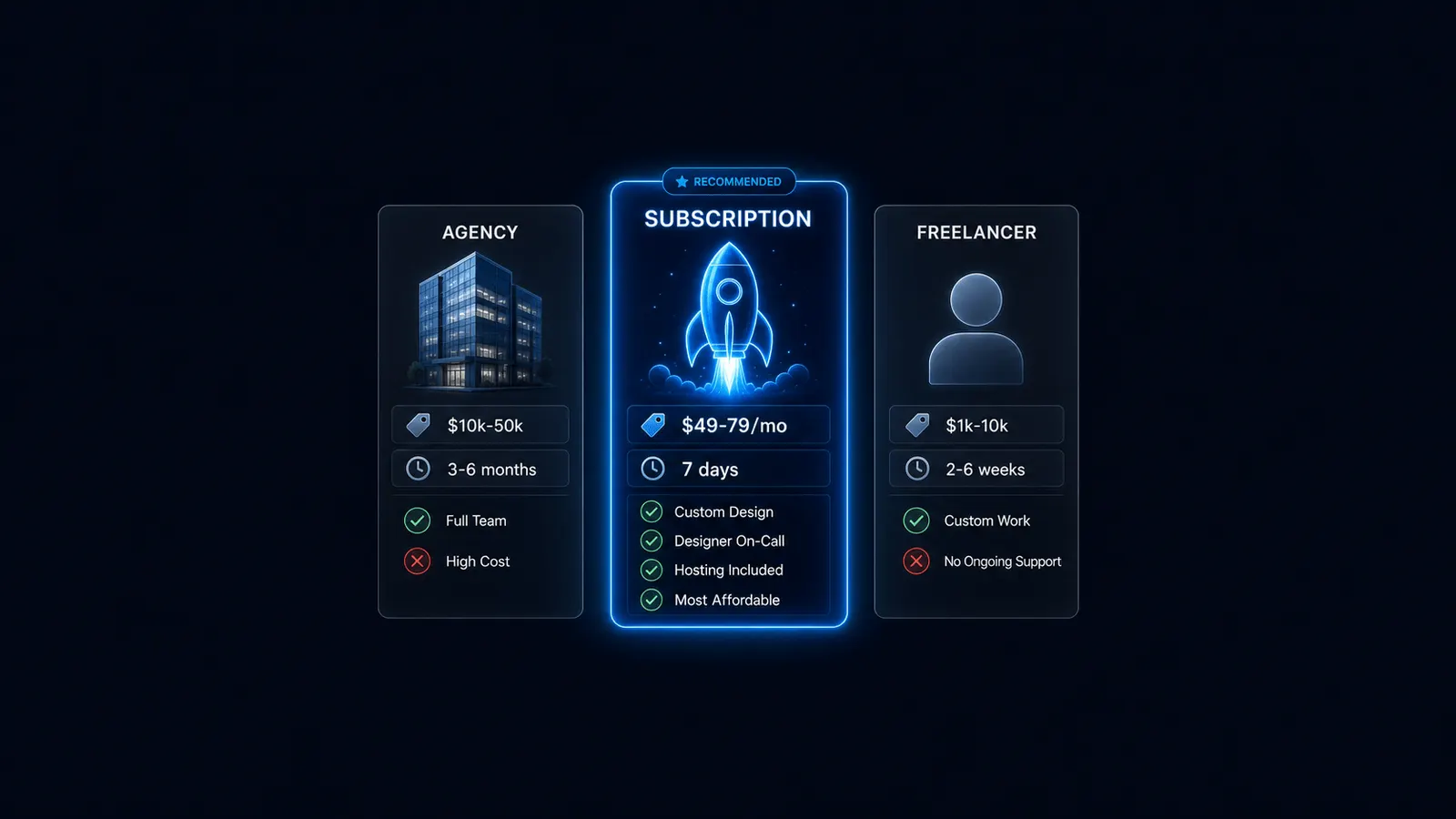
An agency typically runs $5,000 to $25,000 or more, depending on scope and how many specialists touch the project. A freelancer typically runs $500 to $5,000, sometimes up to $8,000 for more complex work. A subscription usually costs $499 to $799 upfront, then a recurring monthly fee that ranges from $49 at the small-business end to $999 or more at the agency/startup end, depending entirely on the tier.
Freelancers typically charge 40% to 60% less than agencies for comparable work, according to a 2026 cost comparison from BKWebDesigns. That gap exists mostly because a freelancer isn’t carrying an agency’s overhead, project management staff, or office costs, not because the work itself is worth less.
What Each Model Delivers
An agency delivers project management, multiple rounds of revisions, and a dedicated team, usually across a six-to-sixteen-week timeline. You’re paying for coordination as much as design.
A freelancer delivers direct communication and, for a simple scope, often the fastest timeline of the three, though everything depends on that one person’s availability and current workload.
A subscription delivers ongoing design and maintenance bundled into the fee, with turnaround measured in days rather than weeks once your site is live. The catch is that request volume caps vary sharply by tier, so “unlimited” on one plan can mean something very different than “unlimited” on another.
The Real Risk in Each Model
An agency carries the lowest single-point-of-failure risk of the three, since a team backs the work instead of one person. That safety net comes at a real cost: higher price and a slower timeline than the other two options.
A freelancer carries the highest single-point-of-failure risk. If they get sick, get busy, or simply disappear mid-project, you’re stuck with an unfinished site and no built-in continuity. Freelancer portfolios are also more prone to being inflated, so vetting matters more here than with an agency or a subscription.
A subscription’s risk looks different. It isn’t about continuity. It’s about paying for the wrong tier. A $549-to-$999-a-month unlimited-request plan is overkill for a business that just needs one clean, well-maintained site and periodic updates, not an ongoing pipeline of new creative work.
Agency vs. Freelancer vs. Subscription: Side-by-Side
| Typical Cost | Timeline | Ongoing Maintenance Included? | Single-Point-of-Failure Risk | Best For | |
|---|---|---|---|---|---|
| Agency | $5,000-$25,000+ | 6-16 weeks | Sometimes, often a separate contract | Low (team-backed) | Complex, mission-critical projects |
| Freelancer | $500-$5,000 (up to $8,000) | Varies with availability | Rarely, usually a separate engagement | High (one person) | Simple, well-defined scope |
| Subscription | $499-$799 upfront + $49-$999+/mo | Days once live | Yes, built into the fee | Moderate (provider-dependent) | Ongoing design and maintenance needs |
Which One Actually Fits Your Business
A freelancer fits a simple, well-defined project with a budget under roughly $5,000, especially if you’re comfortable managing the relationship directly and don’t need much ongoing support afterward.
An agency fits a complex or mission-critical site with a budget of $5,000 or more, where you want a full team backing the work instead of one person’s calendar.
A small-business-tier subscription fits an ongoing local business, a plumber, a therapist, a shop owner, that needs one well-maintained site plus periodic updates, not unlimited monthly design capacity it will never fully use.
A startup-tier subscription, the $549-to-$999-plus-a-month plans from providers like Buzzcube, ManyPixels, or Zyner, fits a funded startup or an in-house marketing team that genuinely needs an ongoing creative pipeline. That’s a real, valid use case. It’s just not the same buyer as the local business this comparison is mostly written for.
Where Astrobot Fits (and Where It Doesn’t)
Astrobot is a small-business-tier subscription, $49 or $79 a month, built for a single business that needs one well-maintained site. It isn’t a competitor to $549-plus platforms built for funded startups and marketing teams. If you’re comparing us against ManyPixels’ Advanced plan, which starts at $549 a month, or its Business plan at $999 a month, you’re probably comparing the wrong tier to your actual need. Learn more about how web design subscriptions work if the model itself is still unfamiliar.
I’d rather tell you honestly that we’re not the right fit for a venture-backed startup’s design pipeline than pretend to be something we’re not. If that’s your situation, a startup-tier subscription or an agency built for that scale is the better call.
Frequently Asked Questions
Is a subscription cheaper than a freelancer over time? It depends on request volume. A small-business-tier subscription is usually cheaper for ongoing maintenance, while a one-off freelancer project can be cheaper if you need a single redesign with no ongoing work afterward.
Can I switch from an agency to a subscription later? Generally, yes. Migrating an existing agency-built site has its own considerations, mostly around redirects and content, covered in the SEO-safe redesign guide.
What happens if my freelancer disappears mid-project? This is the single biggest freelancer risk, and there’s no built-in continuity the way there is with an agency team or a subscription service. It’s worth asking any freelancer directly how they handle this before you commit.
Do subscriptions include hosting and ongoing maintenance? It varies by provider, so confirm exactly what’s bundled before comparing price alone. Two subscriptions at the same monthly rate can include very different things.
The Bottom Line
There’s no single right answer to agency versus freelancer versus subscription, only a right fit for your project. Match the model to your budget, your timeline, and, most importantly, how much ongoing work you’ll actually need after launch, not just the initial build.
If you’ve landed on a small-business-tier subscription as your fit, get a redesign quote to see real pricing for your site, or book a consult if you’re still weighing your options.
Ready to put this into practice? Explore our web design services, view plans & pricing, or book a free consultation — no pressure, just honest advice.