DIY Website vs. Professional: An Honest Comparison
Type “DIY website vs. professional” into Google and you’ll mostly get two kinds of results: a builder platform’s own comparison page insisting you don’t need anyone else, or a developer’s portfolio site insisting you do. Neither side has much reason to give you an honest answer, because both are selling something.
About 32% of small businesses use a DIY website builder to get a basic site up, and roughly 70% of small and medium businesses say cost savings and ease of use are why, according to industry roundups from UI Things and howtohosting.guide. That’s a real, sound decision for a lot of businesses. This is the honest version of the comparison: when that decision still holds, and when it quietly stops.
Key Takeaways: DIY website builders genuinely work well for simple sites with low customization needs and an owner willing to spend a few hours a month maintaining them. They start breaking down around SEO control, scaling past a handful of pages, and the total absence of real support when something goes wrong. Over three years, the gap between DIY and professional narrows more than either side admits.
When DIY Genuinely Works
DIY genuinely works when your business is simple: one location, one clear offer, no complex booking or inventory logic to manage. It also depends on you being willing to spend an hour or two a month on upkeep, because a DIY site left completely alone tends to fall out of date fast. If that’s your situation, a builder platform is a legitimate way to get online, not a compromise you’re settling for.
Wix’s premium plans run roughly $17-159 a month depending on tier, and Squarespace runs about $16-99 a month, based on both platforms’ own 2026 pricing pages. I’d rather point you to Wix.com and Squarespace.com directly for the current numbers than repeat a figure here that either company could quietly change tomorrow. Whatever the exact number is when you check, DIY at the entry tier remains genuinely the cheapest way to get a real website live fast.
This isn’t a section I’m writing to set up a pivot. If your business fits that profile, a professional build would likely cost you more than it’s worth right now. The rest of this piece is about recognizing when that stops being true, not talking you out of a decision that’s currently working.
Where DIY Breaks Down
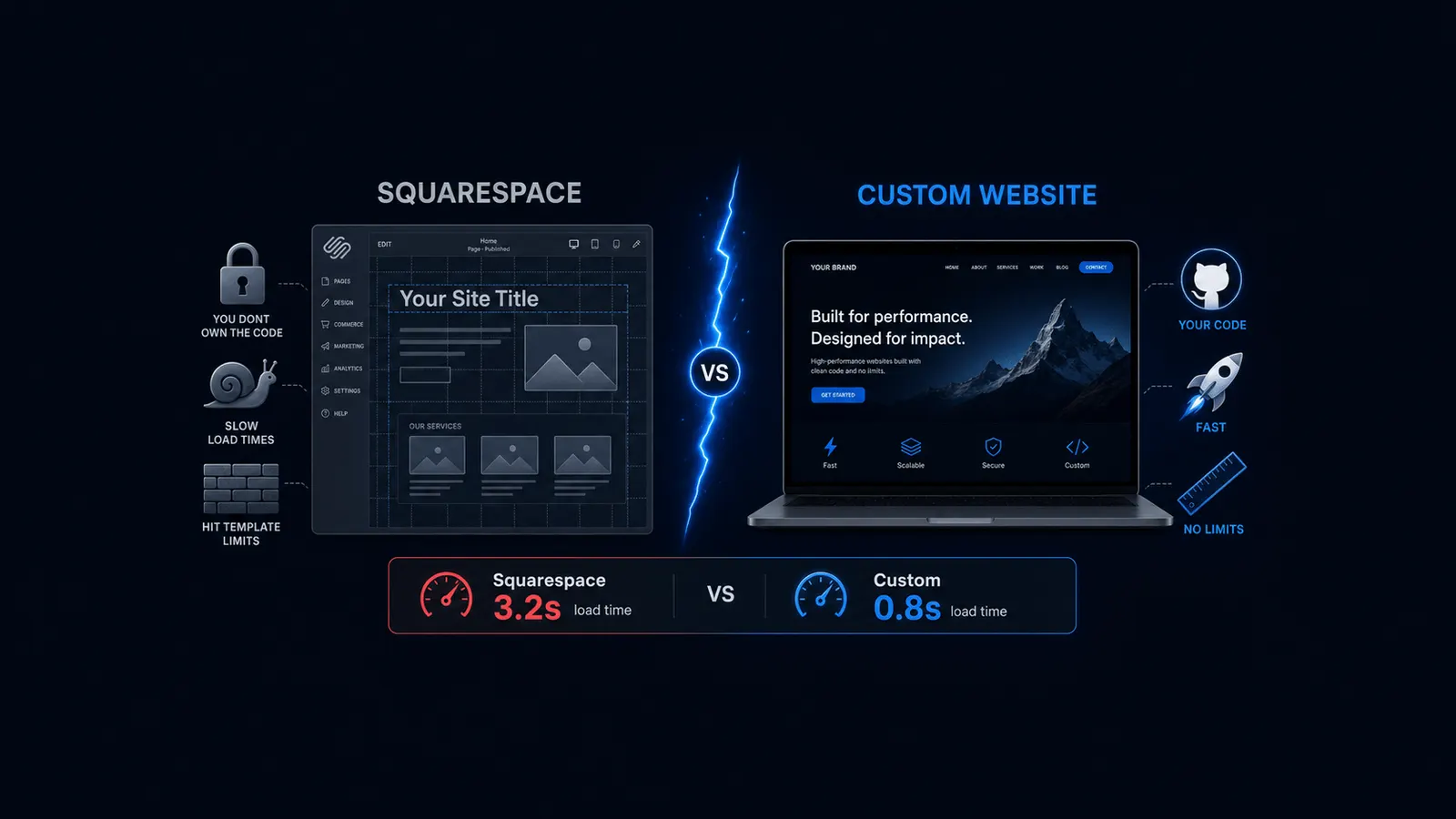
DIY starts breaking down in three predictable places: search visibility, scale, and support. Locked-down builder platforms give you limited or no control over technical SEO fundamentals like robots.txt rules and deep schema markup, which caps how far organic growth can realistically go once you’re past a handful of pages.
Scaling is the second issue. Adding new pages, third-party integrations, or custom functionality on a builder platform means working around its constraints instead of with them. What would be a quick fix on a custom-built site can turn into a multi-app workaround on a template platform.
Support is the third, and it’s the one people underestimate. When a payment integration breaks or a page renders wrong on mobile, DIY means you’re the support team, on your own time, usually during hours you’d rather spend on customers. An estimated 51% of people have abandoned a website project without finishing it, according to UI Things’ 2026 builder statistics roundup. DIY’s low barrier to start is also a low barrier to stall out.
Cost Comparison Over Time
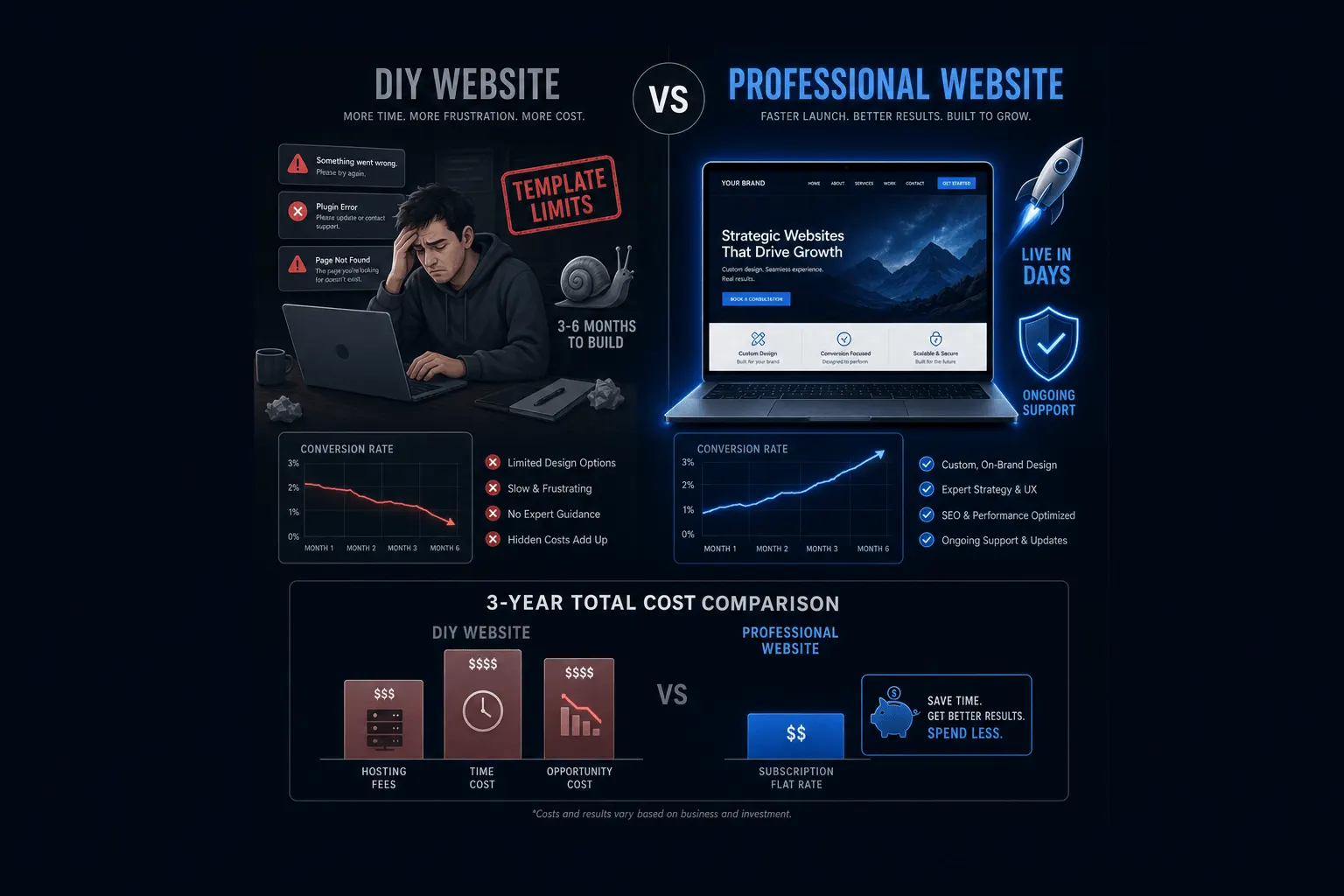
The advertised monthly price on a DIY builder and the real three-year cost of running one aren’t the same number. Here’s a realistic comparison, built from a mid-tier plan with the kind of add-ons most working small-business sites end up needing, next to a flat-rate professional subscription.
| Cost Component | DIY Builder (3 years) | Astrobot Subscription (3 years) |
|---|---|---|
| Base plan | $612-$1,800 (entry to mid-tier, 2026 pricing) | Included in flat rate |
| Apps, storage, domain renewals | $360-$1,800+, varies widely by business | Included in flat rate |
| Eventual professional touch-up, if outgrown | $1,500-$8,000, typical freelance project | Not applicable, changes included |
| Approximate 3-year total | $972-$11,600+ | $1,764 (Orbit, $49/mo) to $2,844 (Supernova, $79/mo) |
Those DIY ranges are illustrative, not a guarantee for any specific business; add-on needs vary a lot, and I’d rather you verify current Wix and Squarespace pricing directly than trust a number that could shift before you read this. The pattern holds regardless: the advertised base price and the real three-year cost are two different numbers.
The “professional” side of this comparison doesn’t have to mean a five-figure agency quote either. Freelance developers typically charge $50-150 an hour, with most small-business freelance projects landing between $1,500 and $8,000 upfront, per cost breakdowns from FreelanceNation and GruffyGoat. A flat-rate subscription is a different structure entirely: no upfront freelance invoice, just an ongoing rate that includes changes.
DIY’s advertised cost and its real cost tend to diverge exactly at the point where a business needs to sell something, add real functionality, or renew a domain past the free first year. I go through those specific fees, transaction costs, app subscriptions, storage limits, line by line in Website Builder Hidden Fees.
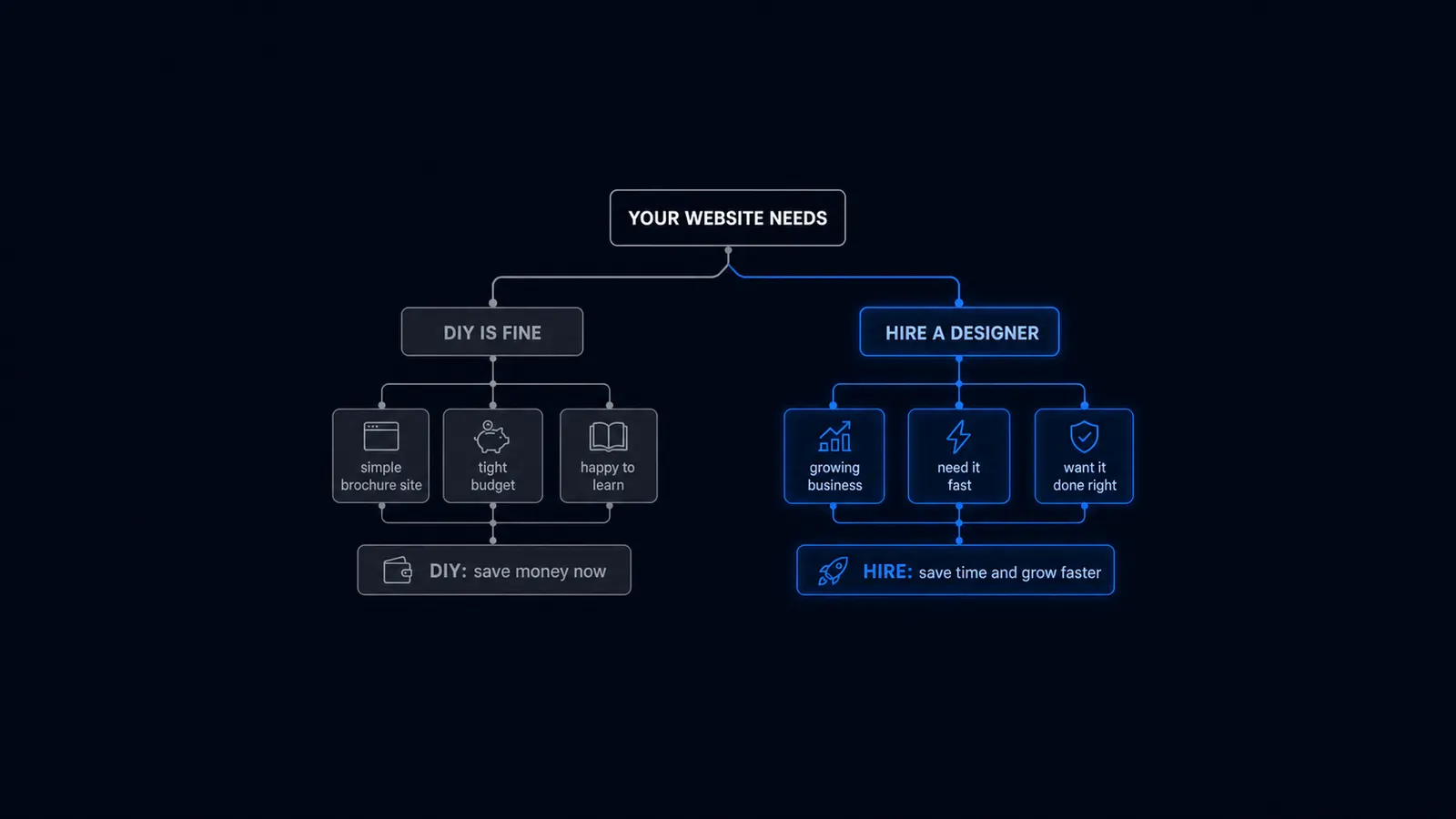
A Decision Framework
- Business complexity: one offer, or multiple products and services?
- Time available for upkeep, honestly, not aspirationally, each month
- Whether SEO-driven growth matters to your business model
- Whether the site needs to change often as the business evolves
None of these answers makes one path better than the other in the abstract. What they do is tell you which one fits your business right now, which is a more useful question than which one is cheaper on paper.
Frequently Asked Questions
Is DIY website building worth it? Yes, for the right business profile. If you match the checklist above, single offer, low upkeep needs, no urgent SEO growth pressure, DIY is a sound, deliberate choice, not a placeholder.
What can a professional do that a DIY builder can’t? Deeper SEO control, custom functionality built around your actual business instead of a template’s assumptions, and ongoing support without you becoming your own IT department.
Can I start DIY and switch to professional later? Yes, and it’s a common, sensible path. The cost comparison above assumes exactly this: start DIY, then move to a professional build once the business has outgrown what the builder can do.
Is a web design subscription the same as hiring a professional? Functionally, yes, with one meaningful difference: it includes ongoing changes at a flat rate instead of billing a new invoice every time you want to update the site.
The Bottom Line
DIY and professional both work. The mistake isn’t picking either one, it’s picking based on the advertised price alone instead of the fuller picture: what you’re trying to build, how much of your own time you’re willing to spend, and how expensive it’ll be to change the site once real customers start telling you what they actually want.
If you’re honest about where your business sits on that checklist, the right answer for you gets a lot easier to see. And if you’re still not sure which side of the line you’re on, When to Hire a Web Designer (and When DIY Is Still Fine) goes deeper on the specific signals worth watching for.
If DIY has started to feel like more work than it’s worth, take a look at Astrobot’s flat-rate subscription plans and see what a professionally built site with ongoing changes included would actually cost you.
Ready to put this into practice? Explore our web design services, view plans & pricing, or book a free consultation — no pressure, just honest advice.