Turnkey Website vs. Custom Build: Which Is Right for You
By the time someone’s comparing “turnkey website” against “custom build,” they’ve usually already ruled out doing it themselves. What’s missing from most of the content on this comparison is a straight answer about which one actually fits which kind of business, instead of just restating that one is cheaper and one is more flexible.
Both are legitimate paths. Turnkey wins on speed and cost. Custom wins on exact fit. Neither is universally better, and the honest framework depends more on what your business actually needs than on your budget alone.
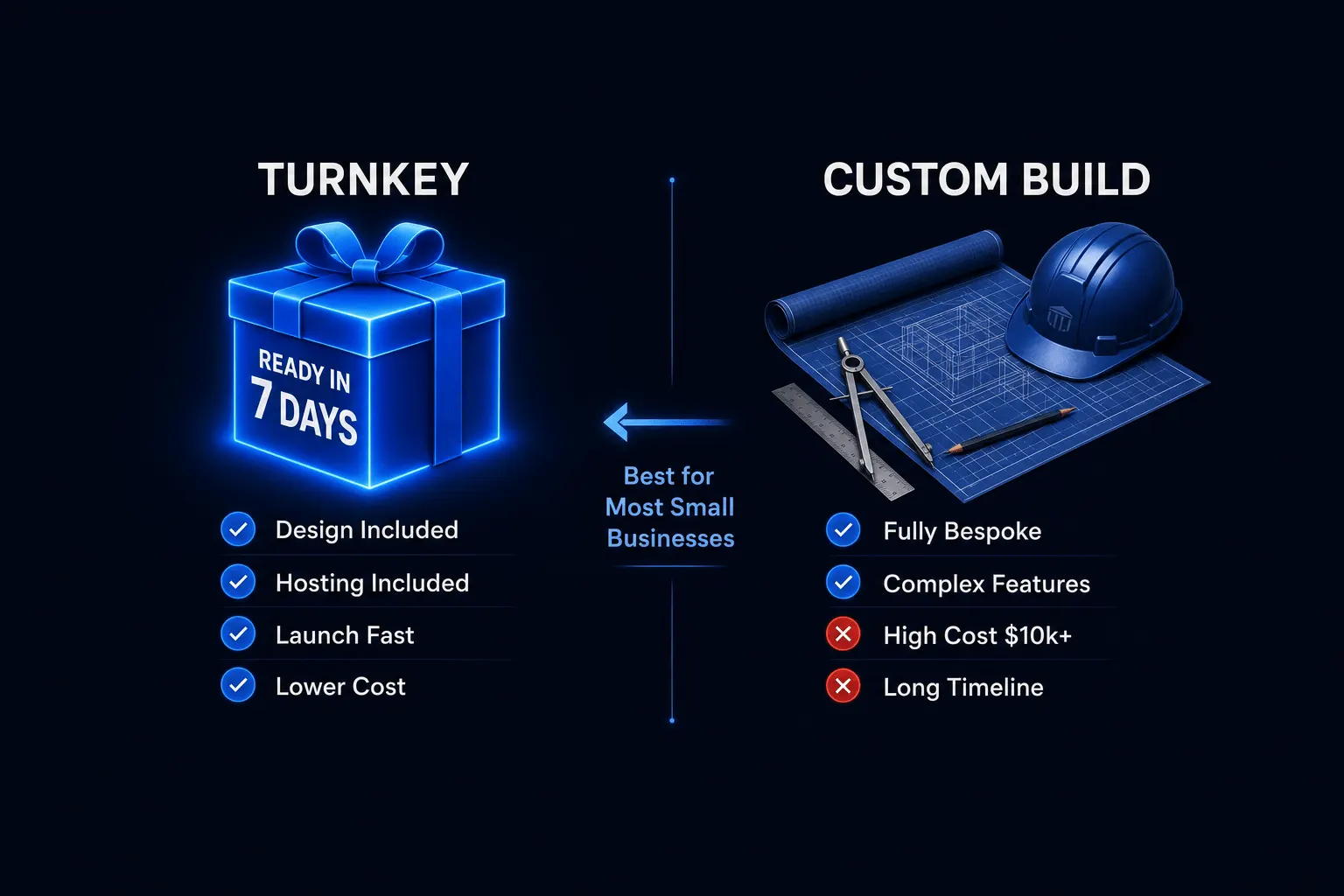
Key Takeaways: Turnkey websites cost less, launch in days instead of months, and work well when your business fits a common pattern: services, a local shop, a simple catalog. Custom builds cost more and take longer but fit unusual business models, complex functionality, or brand requirements a pre-built base can’t stretch to. Most small, local businesses are well served by turnkey; businesses with real functional complexity usually aren’t.
What You Gain With a Turnkey Website
Speed is the clearest advantage. A turnkey site can launch in days, not the weeks or months a custom build takes, because the design and structural decisions are already made before you start.
Cost follows the same logic. Industry roundups tracking small-business website pricing, GruffyGoat, Jim.com, and Elementor among them, put DIY and turnkey-tier solutions in the range of roughly $17 to $50 a month, or $150 to $1,200 a year all in. That’s well under the $1,500 to $8,000 typical for a freelance custom build, or $6,000 to $35,000-plus for an agency build. These are industry-typical ranges pulled from multiple sources, not a single precise figure, so treat them as a directional comparison rather than a quote.
Predictability rounds it out. A fixed price and a known scope mean no open-ended project risk, no wondering whether the quote will grow once work starts.
What You Gain With a Custom Build
Exact fit is the trade you’re making. A custom build is built around your specific business rather than adapted to it, which matters when your operations don’t fit a common pattern.
That fit takes time. Custom small-business site builds commonly average 6 to 12 weeks, per 2026 timeline data cited by Elementor, SolveIt, and Hostinger, with small brochure sites closer to 2 to 4 weeks and larger or more complex builds running 10 to 16 weeks or more. It’s a real project with a real timeline, not a compressed version of a turnkey launch.
A custom foundation also gives you more room to grow in directions a pre-built base sometimes can’t stretch to: complex booking logic, multi-location structures, integrations specific to how you operate.
The Real Cost Comparison Over Time
The market is genuinely split on this, not settled. One figure worth naming with a caveat: some pricing roundups cite that 61% of small business website buyers spent under $10,000 on their most recent project, down from 68% in 2023, suggesting buyers are increasingly willing to pay for more custom, conversion-focused work. I couldn’t trace that specific year-over-year figure to an original, independently verifiable source, so treat it as directional rather than confirmed.
Here’s the part that applies regardless of which path you choose: ongoing costs, updates, hosting, maintenance, can equal or exceed your initial build cost over a 3-year horizon. That’s not a turnkey-specific downside. It’s true of both paths, and it’s worth factoring into the comparison instead of only looking at the upfront number.
Decision Framework by Business Type
Turnkey fits well: local service businesses, single-location shops, and straightforward professional practices where the core need is looking credible and being found, not custom functionality.
Custom fits better: businesses with unusual operational needs, complex booking logic, multi-location structures, custom integrations, or brands where visual differentiation is core to how the business competes.
There’s an honest middle case too: a business that starts turnkey and outgrows it. That’s a legitimate, common path, not a failure of the original decision. Plenty of businesses launch fast on a turnkey site, prove the concept, and move to custom once they know exactly what they need.
How Astrobot Supports Both Paths
For the turnkey path, Astrobot’s marketplace lists ready-to-launch inventory with a design session included. For the custom path, Astrobot’s web design service is built for businesses that need the exact-fit approach.
This is a genuine dual offering, not a turnkey listing with a soft upsell buried in it. Which one makes sense depends on your business, not on which one is more profitable to sell.
| Turnkey | Custom | |
|---|---|---|
| Launch timeline | Days | Weeks to months (commonly 6-12 weeks) |
| Typical cost | Lower, fixed | Higher, project-based |
| Customization depth | A focused design session | Built around your specific business |
| Best fit | Common business patterns | Unusual operational needs or brand requirements |
Frequently Asked Questions
Is turnkey cheaper in the long run, or just upfront? Usually just upfront. Ongoing costs tend to converge over time regardless of path, so the real savings with turnkey is time-to-launch and reduced project risk, not lifetime cost.
Can a turnkey site be customized enough to feel like “mine”? It depends on the provider. Astrobot’s marketplace includes a real design session, not just a logo and color swap, though the exact scope of what that session covers is worth confirming before you buy.
What if I start turnkey and need custom later? That’s a legitimate and common path. If you’re considering it, ask directly what an upgrade or migration path looks like before you buy, since terms vary by vendor.
How do I know which one fits my business? Use the framework above: common pattern versus unusual complexity. When you’re still unsure, a straightforward conversation is the fastest way to get a real answer instead of guessing.
The Bottom Line
Turnkey and custom aren’t competing for the same buyer. Turnkey serves the business that needs to look credible and get found, fast and affordably. Custom serves the business whose needs genuinely don’t fit a common pattern.
Sit with that trade-off honestly instead of looking for the option that’s “just better.” The right answer depends on what your business actually needs, not on which path sounds more impressive.
Start with the full picture: read Astrobot’s complete buyer’s guide to pre-built websites, then browse the marketplace or explore custom web design to see which path fits.
Ready to put this into practice? Explore our web design services, view plans & pricing, or book a free consultation — no pressure, just honest advice.