What Should Actually Be in a Web Design Package (And What Agencies Pad to Justify Higher Prices)
Most small business owners have no idea what they’re paying for when they sign a web design contract.
You get a proposal with line items like “custom design,” “SEO optimization,” and “premium hosting.” The price tag sits somewhere between $3,000 and $15,000. You nod along because everyone else seems to think this is normal.
But here’s what nobody tells you: half of what you’re paying for either doesn’t matter for a small business or comes standard in modern web development.
We’ve built tons of websites at astrobot.design. We’ve seen what moves the needle for small businesses and what just inflates invoices. This breakdown shows you exactly what belongs in a legitimate web design package and what agencies add to justify charging more.
The Six Things Every Small Business Website Actually Needs
A functional small business website requires six core components. Everything else is either optional or already included in modern development.
1. Custom Design
Your website should look like your business. Templates can work for some situations, but custom design means your site reflects your brand, speaks to your specific customers, and differentiates you from competitors.
Custom design doesn’t mean a team of twelve people spending months on mockups. It means a skilled designer who understands your business and builds something that works.
At Astrobot, you get a dedicated designer. One person. You book a design meeting, they build your site, and you launch seven days later. No transfers between departments. No game of telephone.
2. Reliable Hosting
Your website needs to live somewhere. Traditional agencies charge separately for hosting or bundle it at inflated rates.
Here’s the reality: small businesses typically pay $50-60 per month for managed WordPress hosting. Larger businesses pay hundreds. That’s $600-720 per year minimum, often reaching $1,200 or more once you add security plugins, CDN layers, and performance tools.
Modern static site hosting through platforms like GitHub Pages or Netlify costs dramatically less. GitHub Pages is completely free for static sites. Netlify’s paid plans start around $19/month and handle significantly more traffic than most small businesses will ever see.
We include enterprise-grade hosting in both our plans. Our $49/month Orbit plan and $79/month Supernova plan both come with hosting built in. You’re not paying extra. You’re not getting surprise invoices when traffic spikes.
3. Mobile Responsiveness
This shouldn’t even be a line item anymore, but agencies still list it as a feature.
Mobile responsiveness is table stakes. 73.1% of web designers say non-responsive design is a top reason visitors leave websites. Yet 91% of small businesses still don’t have responsive sites.
The gap creates opportunity. When 61% of users won’t return to a mobile site they had trouble accessing and 40% visit a competitor instead, responsive design directly impacts your revenue.
Every modern framework builds mobile-first by default. If an agency charges extra for mobile responsiveness in 2026, they’re padding the invoice.
4. SEO Optimization
SEO matters, but most agencies either overcomplicate it or use it to justify ongoing retainers.
Basic SEO optimization means clean code, fast load times, proper heading structure, meta descriptions, and a sitemap. These are fundamentals that should come standard with any professional website build.
Advanced SEO requires ongoing work: keyword research, content strategy, link building, and technical audits. That’s where specialized agencies like SearchSerpa add value. But the baseline SEO setup belongs in your initial package.
Our sites load in as little as 50 milliseconds. WordPress sites typically take 500-800 milliseconds. Google pays attention to page speed. When your site loads 10-16 times faster than competitors, you get an SEO boost without paying for expensive plugins or optimization services.
5. A Blog
If you plan to grow through content or improve your search rankings, you need a blog. This is where most agencies either charge thousands extra or skip it entirely.
We spent over a year mastering headless WordPress integration specifically so we could include blogs in our standard packages. Every time your site builds, blog content gets pulled from WordPress and rendered as static pages. You get the familiar WordPress editing experience with the performance of a static site.
The result: your SEO skyrockets because all the data is statically rendered. We can build 500 blog articles in less than the blink of an eye. Google loves that speed.
6. Ongoing Support
Websites aren’t one-and-done projects. Your business changes. You add services. You update pricing. You change your address or add a second location.
Traditional agencies charge hourly for updates or require new project contracts. You end up paying $150-300 per hour for simple text changes.
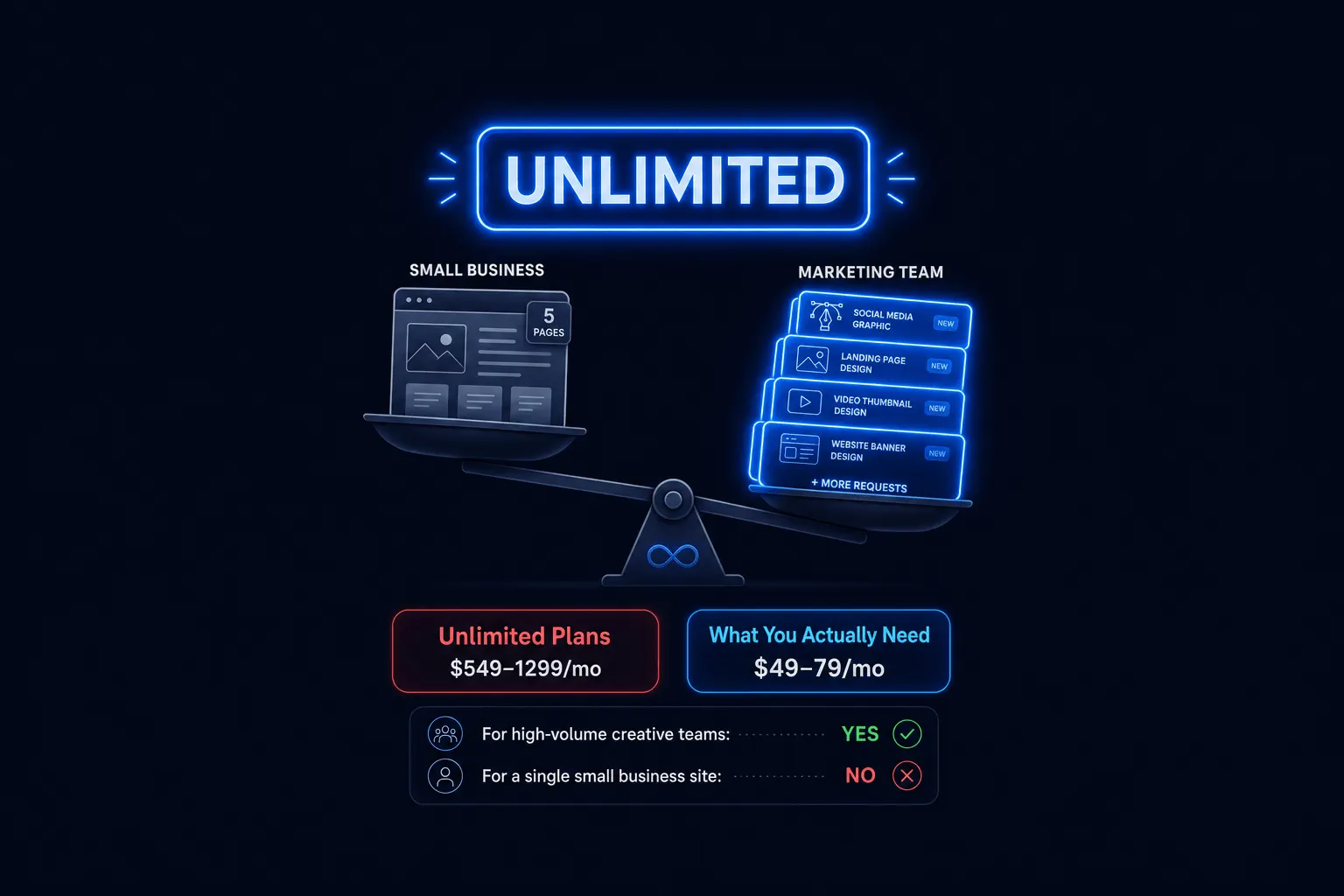
Subscription models solve this. Our Orbit plan includes up to 4 monthly updates. Supernova includes unlimited updates. You message your dedicated designer, and they make the change. No invoices. No project scoping. No waiting weeks for a simple fix.
This is where subscription pricing shows its value. You’re not paying for revisions. You’re not trapped in launch-day decision anxiety wondering if you got everything perfect. You have a designer who grows with your business.
What Agencies Add to Justify Higher Prices
Now let’s talk about the padding.
Premium Hosting Packages
Agencies love to bundle “premium managed hosting” at $100-200/month. They’ll tell you it includes automatic backups, security monitoring, and 24/7 support.
Here’s what they don’t mention: modern static site architecture handles security and performance natively. There’s no PHP to update, no plugin conflicts to resolve, no server to patch. The infrastructure itself eliminates most of what “premium hosting” claims to solve.
A mid-sized WordPress site on managed hosting runs $50-100/month through providers like Kinsta, WP Engine, or Flywheel. That’s $600-1,200 per year just for hosting, before you add premium plugins, security tools, or CDN layers.
Static sites deploy to platforms with generous free tiers or low-cost paid plans. The WordPress install that acts as your CMS only needs basic hosting since it never serves public traffic. A $10-20/month VPS handles it fine.
Multi-Person Teams
Traditional agencies pitch teams of specialists: project managers, UX designers, developers, copywriters, SEO experts. You’re paying for each person’s time, even when most of that coordination is unnecessary.
The truth: having twelve people work on one small business website creates complexity, not quality. You end up in endless revision cycles, playing telephone between departments, and paying for meetings about meetings.
One skilled designer leveraging an AI tech stack who understands your business delivers better results faster. We’ve proven this over and over again. Design meeting on day one. Launch meeting on day seven. No bloat. No bureaucracy.
Extended Timeline Padding
Traditional agency timelines stretch 4-6 weeks or longer. Some of that is legitimate work. Much of it is artificial scarcity and project management overhead.
The biggest hidden cost is delay. In 2026, speed matters. A website that’s live and working will always outperform a perfect site that never launches.
We launch in seven days because we’ve eliminated the unnecessary steps. No multi-week discovery phases. No endless revision rounds. No waiting for the project manager to schedule the next check-in.
Proprietary CMS Systems
Some agencies build sites on proprietary content management systems. They’ll tell you it’s “custom-built for your needs.”
What they mean: you’re locked in. Want to move to another provider? You’ll need to rebuild from scratch. Want to make updates yourself? You can’t. You’re dependent on them forever.
We use headless WordPress. You own your content. You can export it anytime. You’re never trapped.
Unnecessary Integrations and Features
Agencies pad proposals with features most small businesses don’t need: advanced analytics dashboards, custom CRM integrations, elaborate animation libraries, multi-language support.
Some businesses need these. Most don’t. A sandwich shop with occasional menu updates doesn’t need a custom CRM integration. They need a clean site that loads fast and makes it easy for customers to find their menu and location.
We ask what your website needs to do, then build exactly that. If you need specific integrations later, we can add them. But we don’t sell you features you’ll never use just to inflate the project scope.
What $49/Month Actually Delivers vs. What a $3,000 Build Includes
Let’s compare directly.
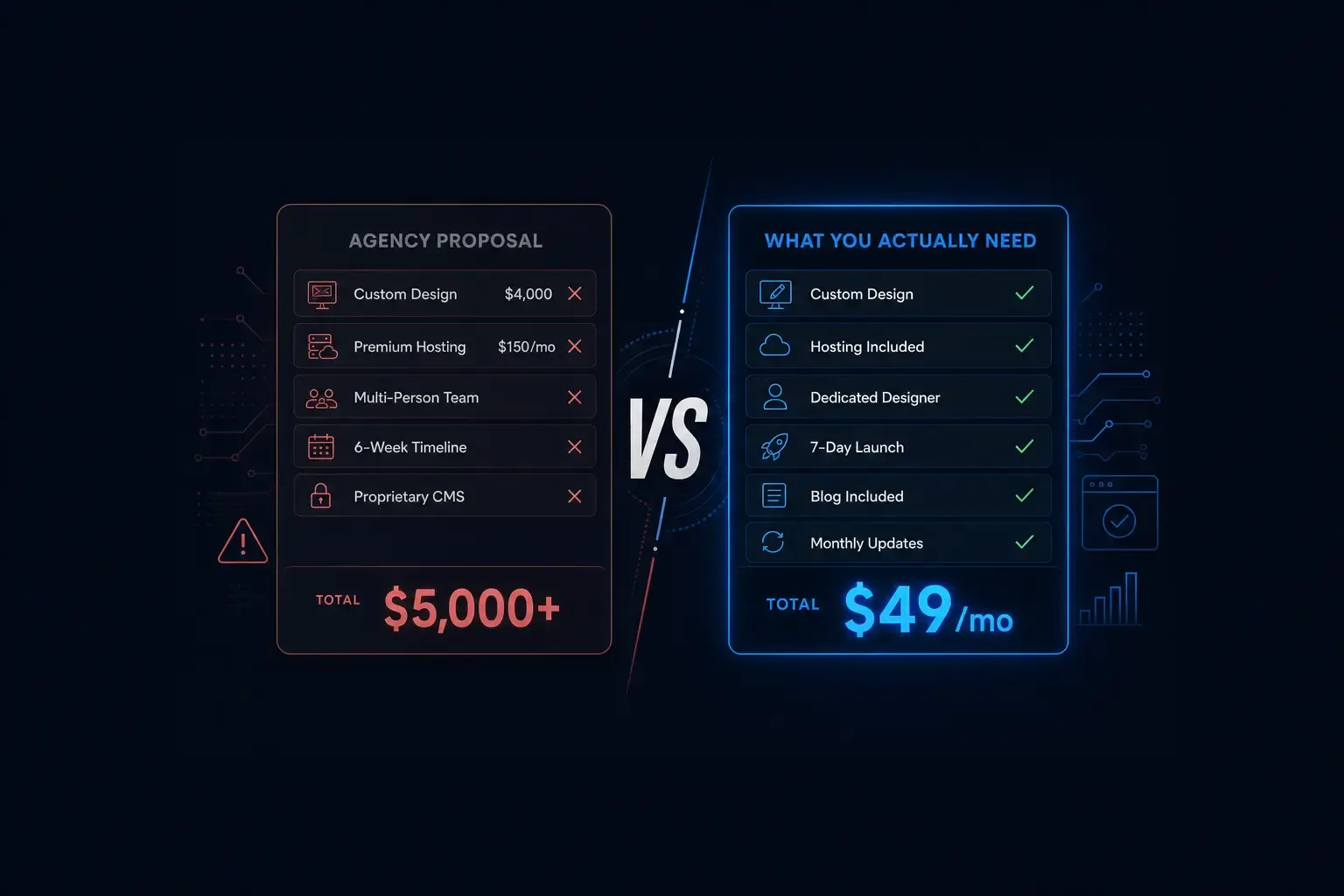
Traditional $3,000-5,000 one-time build typically includes:
- Custom design (after 4-6 weeks)
- 5-10 pages
- Basic SEO setup
- Mobile responsive design
- Contact form
- First year hosting (sometimes)
- 30-60 days of post-launch support
What happens after:
- Hosting bills start ($50-100/month)
- Updates cost $150-300/hour
- Security and maintenance are your problem
- Want to add a blog? New project, new invoice
- Need changes? Get back in the queue
Our $49/month Orbit plan includes:
- Custom design (7-day launch)
- Up to 3 pages
- Enterprise-grade hosting included
- Dedicated designer (one point of contact)
- Up to 4 monthly updates/revisions
- Mobile responsive design
- SEO optimized
Our $79/month Supernova plan adds:
- Unlimited pages
- Headless WordPress blog included
- Unlimited monthly updates/revisions
- Micro-interactions and animations
- Everything else from Orbit
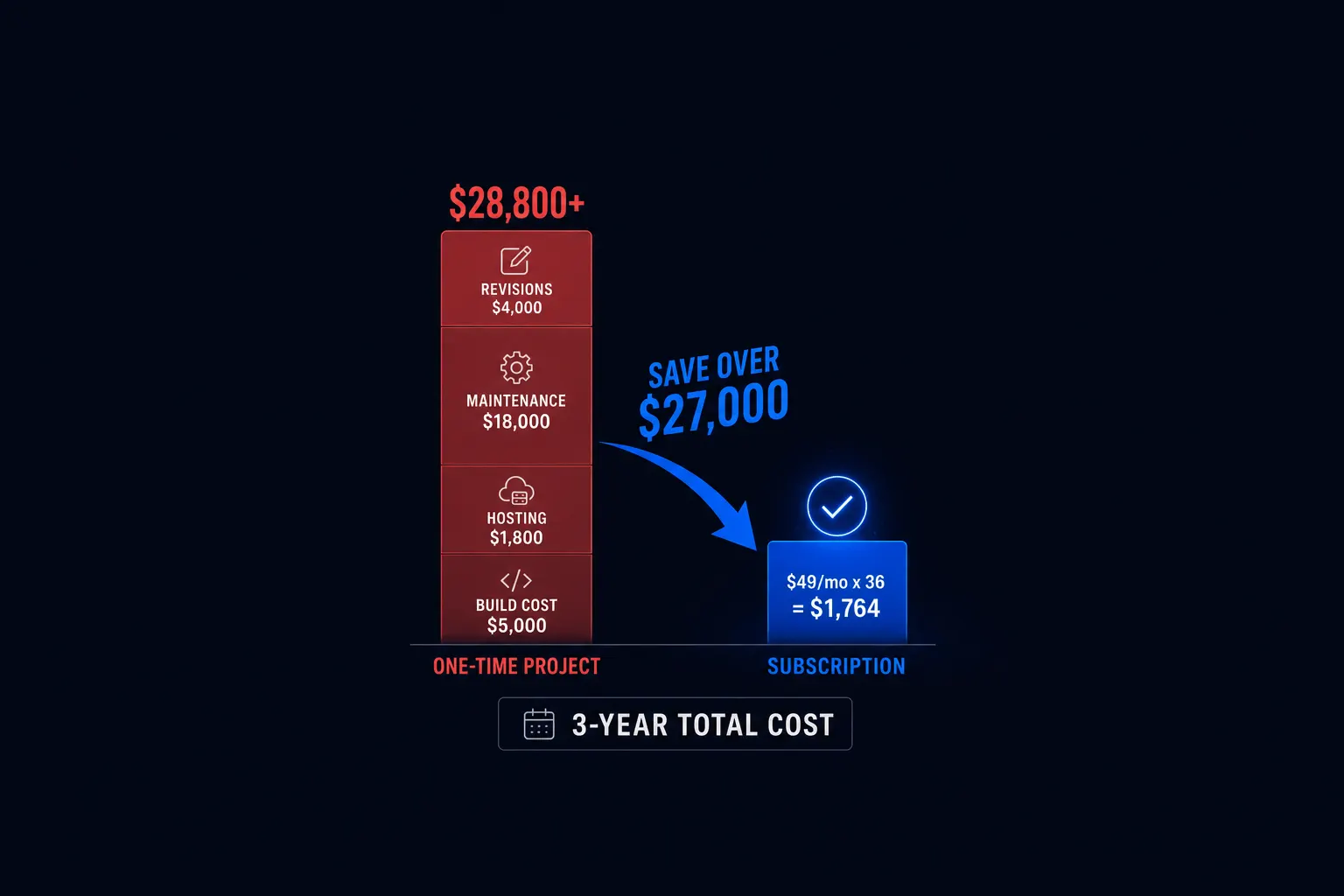
The math is straightforward. Traditional hosting alone costs more than our Orbit plan. Add hourly update fees, and you’re spending $1,500-3,000 per year on a site that’s harder to change and slower to load.
Our subscription model treats your website as a living asset. Your business evolves. Your site evolves with it. No surprise invoices. No revision fees. No anxiety about whether you can afford to update your pricing page.
How to Audit a Web Design Proposal
When you’re evaluating proposals, ask these questions:
What’s included in the base price? Get specifics. How many pages? How many rounds of revisions? What happens after launch?
What are the ongoing costs? Hosting, maintenance, updates, security. Add it up for three years. Compare that total to subscription alternatives.
Who owns the content and code? Can you export your site and move it elsewhere? Or are you locked into their proprietary system?
What’s the timeline? How long until you’re live? What’s causing the delays? Is it legitimate work or project management overhead?
Who’s your point of contact? Will you work with one person or get transferred between departments? How quickly do they respond to update requests?
What happens if you want to add features later? New project? Hourly billing? Included in your plan?
These questions expose the padding. Legitimate agencies will answer clearly. Agencies that rely on confusion and complexity will dodge or deflect.
The Real Cost of Traditional Web Design
Traditional web design costs fall into three categories: upfront build costs, ongoing operational costs, and hidden opportunity costs.
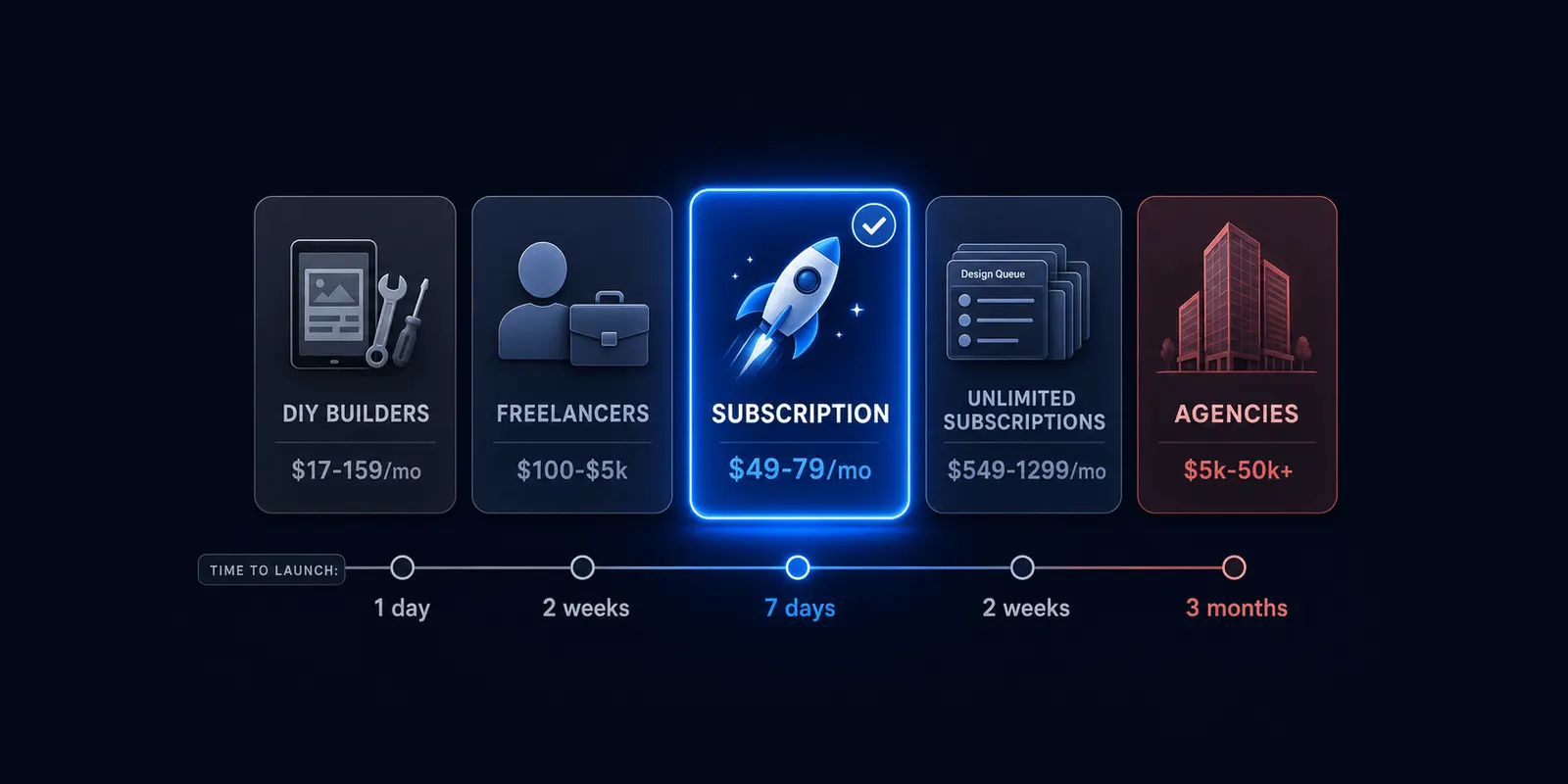
Upfront costs: $3,000-15,000 for small business builds. Agency builds run $10,000-35,000. You’re paying for teams, timelines, and overhead.
Ongoing costs: $1,100-5,000 per year for hosting, security, backups, and marketing tools. Most owners overlook these when comparing proposals.
Opportunity costs: Weeks or months of delay before launch. Inability to make quick changes. Dependence on agency availability for simple updates.
Subscription models eliminate the upfront barrier and make ongoing costs predictable. Instead of finding several thousand dollars upfront, you spread the cost into manageable monthly payments. Instead of paying hourly for updates, you have a dedicated designer on tap.
The model works because it aligns incentives. We succeed when your business succeeds. We’re not trying to maximize project scope or bill hours. We’re trying to get you live fast and keep your site working as your business grows.
Why Speed Matters More Than Perfection
We’ve worked with entrepreneurs who sat on business ideas for years because they thought launching was expensive or complicated.
The biggest cost isn’t money. It’s time.
A website that launches in seven days and evolves over time beats a perfect website that takes three months. You start attracting customers sooner. You learn what works sooner. You generate revenue sooner.
Even a one-second delay in page load time results in a 7% reduction in conversion rates. A site that loads in 1 second has an e-commerce conversion rate 2.5x higher than a site that loads in 5 seconds.
Our sites load 75% faster and run 90% smaller than traditional websites. That speed translates directly to revenue. More visitors stay. More visitors convert. More visitors return.
But the speed advantage isn’t just technical. It’s operational. Seven days from design meeting to launch. Updates handled within 24-48 hours. No waiting weeks for simple changes.
That responsiveness unlocks creativity. Business owners stop treating their website like a static brochure and start using it as a dynamic tool. They test new offers. They update messaging. They add services. The site becomes an asset that grows with the business instead of a project that gets finished and forgotten.
What You Should Actually Pay For
Legitimate web design packages should include custom design, reliable hosting, mobile responsiveness, basic SEO optimization, a blog (if you need one), and ongoing support.
Everything else is either padding or specialized work that belongs in a separate engagement.
Advanced SEO strategy? Hire a specialist like SearchSerpa.com after your site launches. Complex custom integrations? Scope them separately once you know you need them. Multi-language support? Add it when you’re actually serving international customers.
Start with the essentials. Launch fast. Evolve as you grow.
The subscription model makes this possible. You’re not locked into launch-day decisions. You’re not paying thousands upfront for features you might not need. You’re paying a predictable monthly rate for a site that works and a designer who’s there when you need changes.
Traditional agencies will tell you this approach is too simple. They’ll say you need discovery phases and stakeholder workshops and comprehensive strategy documents.
What you actually need is a website that loads fast, looks professional, and helps you grow your business. Everything else is negotiable.
We’ve built this model because we’re entrepreneurs ourselves. We wanted transparency upfront. We wanted predictable costs. We wanted to launch fast without sacrificing quality.
That’s what legitimate web design packages should deliver. No padding. No complexity. No surprises.
Just a website that works and a designer who’s there to help it grow.
Ready to put this into practice? Explore our web design services, view plans & pricing, or book a free consultation — no pressure, just honest advice.