Flat-Rate vs. Hourly Web Design: What's the Real Difference
I’ve read a lot of web design quotes over 20-plus years of building sites, and the ones that go sideways almost always have one thing in common: an hourly rate with no ceiling on it. Not because hourly billing is dishonest. It’s usually the client who eats the extra cost when a project runs long, and most people signing that quote don’t realize it until the third invoice shows up higher than the first two combined.
Nearly half of all creative and web projects run into scope creep, work added after the project starts that wasn’t in the original estimate. When billing is hourly and open-ended, that added work becomes a new line item every time. When billing is flat-rate, the provider is the one who has to absorb it, or fight you over what “in scope” actually means. Neither model is a scam. But only one of them protects your budget by default, and this post walks through exactly which one, and why.
Key Takeaways: Hourly billing charges for every hour logged, so the final bill depends on how the work actually goes, and scope creep hits close to half of all projects. Flat-rate billing sets one price for a defined scope before work starts, shifting the estimating risk to the provider instead of you. Flat-rate only protects you if that scope is written down clearly, not just implied in a conversation.
How Hourly Web Design Billing Works (and Where It Goes Wrong)
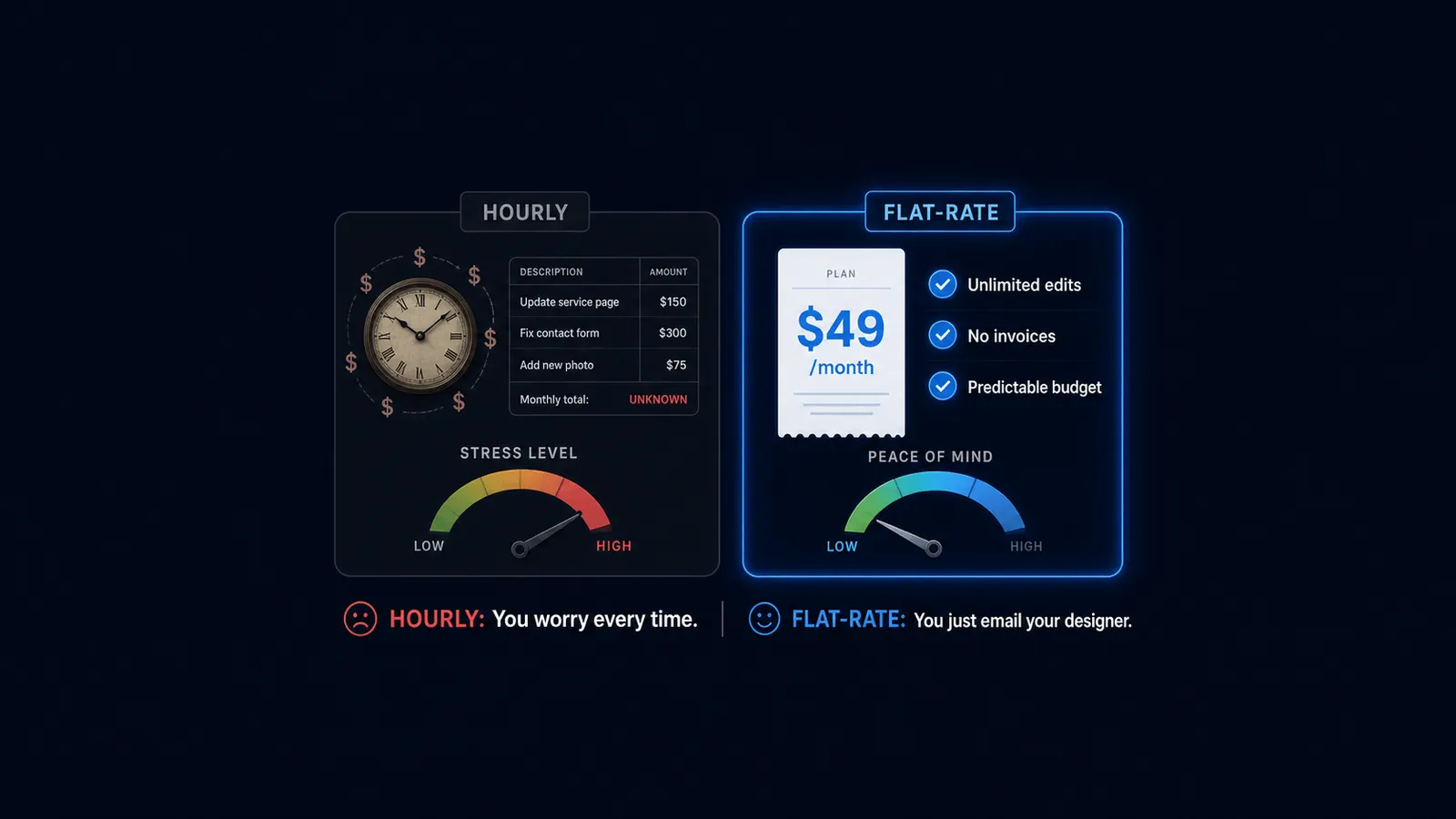
Hourly billing charges a rate, commonly $50 to $200 or more per hour depending on the designer’s experience and specialization, for every hour actually logged against your project. There’s no fixed ceiling unless a “not-to-exceed” cap gets written into the contract before work starts. That’s the whole mechanism, and on paper it sounds fair: you pay for exactly what gets done, nothing more.
In practice, it puts the estimating risk on you, the client. Industry data on scope creep is widely cited at around 52% of projects, up from 43% in 2018, with average cost overruns running somewhere in the 25 to 27% range on the original estimate. I’d treat that as a commonly cited industry estimate rather than a hard, independently verified figure, since most of the roundups reporting it trace back to aggregator sites, not a single primary study. Still, the direction of the number matches what I’ve watched happen on real projects for two decades: every unplanned revision, every “can we just also add,” every miscommunication about what “done” means becomes its own new line item.
Hourly billing genuinely is the right fit somewhere. Open-ended, evolving projects, ongoing custom development where nobody fully knows the scope yet, benefit from a model that pays for actual time spent rather than forcing a premature guess. That’s rarely the situation for a standard small-business website, though. A 5-page site for a plumber or a therapist is about as well-defined as a web project gets.
How Flat-Rate Web Design Works
Flat-rate billing sets one price for a defined scope of work before anything starts. If the job takes longer than the provider estimated, that’s the provider’s problem, not yours. That’s the entire appeal, and it’s a real one: predictability replaces the open-ended risk that hourly billing carries.
But flat-rate pricing only works if “scope” actually gets written down: pages, features, number of revision rounds, what counts as included and what doesn’t. Skip that step and the dispute doesn’t go away, it just moves. Instead of arguing over “how many hours did you actually work,” you end up arguing over “was that in the original scope.” A flat-rate quote with no written scope document is barely different from a handshake deal.
Fixed-price models work best for standard, well-defined builds. A 5-page small-business site fits that description almost perfectly. Genuinely custom, unpredictable work, an unusual integration, a feature nobody’s built before, gets riskier to price flat, because nobody can fully scope the unknown.
Real Cost Comparison: Hourly vs. Flat-Rate for a Typical Small-Business Site
Take a standard 5-page small-business site as the example. Billed hourly at $50 to $200 an hour, across an estimated 20 to 40 hours, that lands somewhere between $1,000 and $8,000 before any scope creep gets added. Apply that widely cited 25 to 27% overrun and the low end alone can climb past $1,250, with the high end pushing well beyond $8,000 once a few “quick changes” get logged.
Astrobot’s own structure runs flat: a $499 to $799 one-time setup fee, then $49 to $79 a month depending on the plan, with hosting and ongoing changes included. There’s no separate invoice for “just one more edit.” You can see the current numbers on Astrobot’s flat-rate plans.
I want to be honest about the trade-off here instead of pretending flat-rate always wins on the sticker price. Flat-rate providers price in a buffer for their own risk, so on a single lean job, an efficient hourly freelancer can genuinely come in cheaper up front. The protection flat-rate offers isn’t in the initial number, it’s in what happens after the quote, once the project is underway and things inevitably shift.
| Billing Model | Typical Range (5-Page Site) | Who Absorbs Overruns |
|---|---|---|
| Hourly, no cap | $1,000–$8,000+ before scope creep | You, the client |
| Hourly, not-to-exceed cap | Same range, capped by contract | Shared, if the cap is enforced |
| Flat-rate (Astrobot) | $499–$799 setup + $49–$79/month | The provider |
Questions to Ask Any Provider About Their Billing Structure
These are the questions worth putting in writing, literally paste them into an email, before you sign anything, regardless of which provider you’re talking to:
- Is this quote hourly or flat-rate, and if hourly, is there a not-to-exceed cap?
- What exactly is included in this price: pages, revision rounds, hosting, ongoing changes?
- What happens if I ask for something outside the original scope? Is there a change-order process, and what does it cost?
- Is there a written scope document, or is this estimate based on a conversation?
- If this is a subscription or flat-rate model, what’s actually unlimited, and what triggers an extra charge?
If a provider can’t answer the first two questions clearly and quickly, that’s information too. To see how the subscription model handles these same questions structurally, this breakdown of how web design subscriptions work is worth a look before you compare quotes.
Frequently Asked Questions
Is flat-rate always cheaper than hourly? Not necessarily on the initial quote. It’s cheaper on average once scope creep is factored in, because the provider, not the buyer, absorbs the overruns.
What is scope creep? Work added to a project after it starts that wasn’t in the original estimate, usually billed as extra hours if the contract is hourly.
Can a flat-rate quote still go over budget? Only if you ask for something outside the agreed scope. A clearly written scope document is what actually makes flat-rate pricing predictable.
Is hourly billing ever the better choice? Yes, for genuinely open-ended or evolving projects where nobody can define the full scope up front. That’s rarely true of a standard small-business website.
The Bottom Line
The billing model on a quote tells you who’s holding the risk once the project starts, not whether the provider is good or bad at their job. Hourly puts that risk on you unless a cap is written in. Flat-rate puts it on the provider, but only if the scope behind that flat number is actually written down. Before you sign anything, ask for the scope in writing, whichever model you’re looking at.
If you’d rather skip the hourly-vs-flat-rate math entirely, check Astrobot’s flat-rate plans to see what a defined, predictable monthly price actually looks like for a small-business website.
Ready to put this into practice? Explore our web design services, view plans & pricing, or book a free consultation — no pressure, just honest advice.