How Much Does a Website Cost for a Small Business? (Honest Answer)
You want a straight answer about how much a website costs for your small business. You're tired of vague quotes and worried about getting ripped off.
I've been there.
As entrepreneurs who've launched multiple businesses, my co-founder and I have hired everyone from cheap freelancers on Fiverr to agencies. We've gotten quotes ranging from $300 to $12,000 for what seemed like the same thing.
Here's what we learned the hard way—and what you should actually expect to pay.
Why Website Costs Vary So Wildly ($500 to $50,000)
The range isn't random. It reflects completely different approaches to building your site.
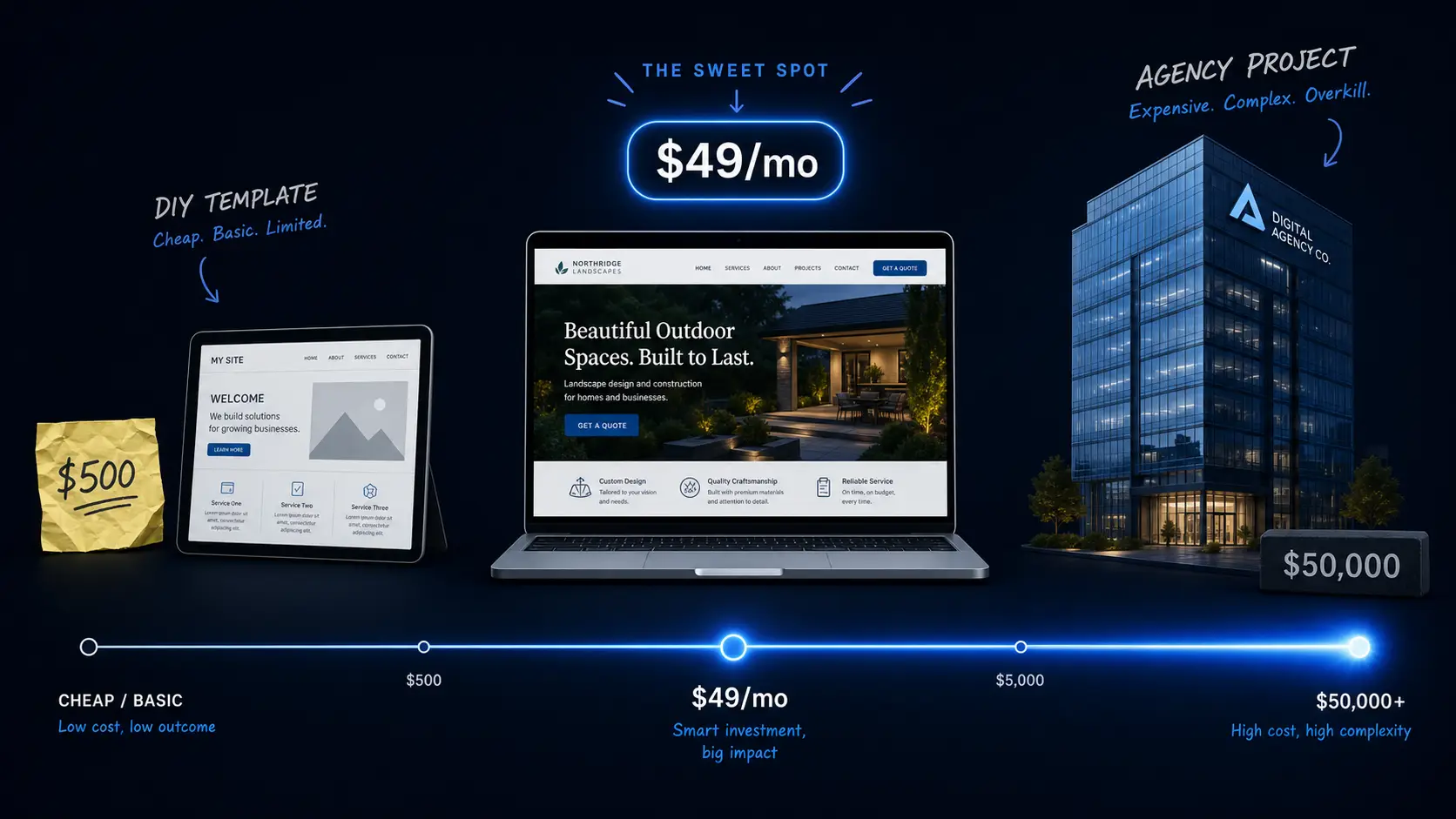
A $500 website usually means you're doing most of the work yourself using a template. A $5,000 website typically involves a freelancer creating something custom. A $50,000 website means you're hiring an agency with a full team creating an entire online world for your brand.
But here's what I wish someone had told me when I was starting out: The initial cost is only part of the story.
If you hire a web designer, don't forget to factor in:
-
Monthly hosting fees
-
Domain registration
-
SSL certificates
-
Ongoing updates and maintenance
-
Content changes
-
Technical support when something breaks
-
Getting hacked by Russians (Turned a piano business website into a porn site)
Your "cheap" $500 website can end up costing you another $3,000 in the first year just for updates, security and other things. Agencies easily charge $125 per hour for simple text changes. In all reality, many of them hope you don't ask about revision costs before they do your build, and many small business owners simply don't. That gives the agency all the power to hold your website hostage! I have personally witnessed this before with my local church. What made matters even worse is the agency framed themselves as a group that specifically desired to help non-profit organizations, when in reality it was search engine optimization targeting small non-profits. My pastor's wife spent hours on the phone trying to get them to release her domain, which they owned by every right anyway.
DIY Website Builders: What We Learned Using Them
We've built sites on Wix and Squarespace ourselves—$16 to $49 per month. You pick a template, drag and drop some elements, and you're live. I am NOT against DIYers! I learned everything that I have because of all the websites that I built for myself. Astrobot is a product of a need that we were trying to meet as entrepreneurs ourselves. We didn't originally plan on launching for other people. Everything I know how to do, I know because of getting in the trenches and learning how to do it myself. That being said, I have also spent hundreds of hours learning, probably actually thousands in all reality. Those came at a cost to my business, my team, the growth of the companies I ran, and worst of all, my family. My now eleven-year-old son was sitting in my lap in diapers when I rebuilt one of my primary company's websites, working all hours of the night trying to get it done.
For your first side hustle, This can seem perfect. Low cost, no technical knowledge required, and launched in a weekend.
Here's what you'll find later. :
Speed. Our Wix site loaded painfully slowly. DIY platforms are built to work for millions of different businesses, so your site carries extra code you don't need.
Customization. You hit walls constantly. Every time we wanted something specific to match our brand, we'd find ourselves fighting the template.
Performance. Things like your bounce rate can be terrible. Google's algorithm favors fast sites, and yours will be losing to competitors that have faster-loading web pages.
Ownership. You're renting space on their platform. When you want to move to something better, you will basically have to rebuild from scratch.
DIY builders work if you need something basic and temporary. But as entrepreneurs trying to scale, it’s easy to outgrow your builder fast.
Every website we build has a dedicated GitHub repository, This repository contains the entire code of your website, and it is owned by you. Take it somewhere else, make changes or edits, it’s yours. Your code stays in your ownership from day one. and can be transferred to any host in the entire world. Or any other developer or designer, for that matter. Or you can even plug it in to your own visual editor and manage it yourself just like you would in Wix or Elementor.
Hiring Freelance Web Designers: Produces Mixed Results
Personally, I've always found it difficult to communicate my vision or brand with a designer or agency. Communication is always what held me back from hiring one until I finally broke down and decided to attempt to do it. I was running a company that was producing revenue, training new employees, and trying to scale. I no longer had time to DIY it anymore. I interviewed multiple designers after sending emails out to those that I found in my price range. Some of them were international, but I specifically stated in my emails how important it was that we were able to communicate.
During one of the interviews, I explained how important communication was and wanted to make sure that my vision was heard. I asked him if he thought he could do that, and he replied to me, "Yes." Then I explained a little bit more about what I needed, and he replied "yes" again after the end of every statement. I then asked him a very specific question about PHP and implementing it in our design for a functioning form, and his response was again "yes." I realize in that moment he didn't even speak English and was just replying "yes" no matter what I said, and was planning on building a website for us. I swear this is an absolute true story, not made up!
I am not trying to say this is the case for everybody. Just sharing a personal story. I think this is one of the things that I pride myself in as the lead designer at Astrobot: the ability to try to listen and hear someone's vision and make it come to life. I go out of my way to do this because of my own personal experiences. You have to click with your designer. They have to get you, and if you are dealing with a freelancer that just churns out website after website for a living, chances are they not going to get you.
At Astrobot, you are talking to entrepreneurs. You are talking to people who have built their own sites because they are just like you. They are launching something they care about. We understand wanting to be able to speak and see it come into existence. That's what I try to do my best at every day. Every website.
Web Design Agencies: When We Almost Hired One (And Why We Didn't)
For another venture, I seriously considered an agency. The pitch was compelling. A whole team—strategists, designers, developers, and project managers—all working on our project. They offered to start with an in-person whiteboard session with their entire team around the table, which sounded like a dream to me! To finally be heard and hopefully communicate Quite frankly, it was a dream because when the price finally came out it was too far out of my reach.
We understood agencies make sense when:
You need complex functionality. Custom applications, membership systems, or e-commerce with thousands of products.
You have a large budget. If we'd been spending $50,000 on a website, we probably would've had the revenue to justify it.
You need a lot of ongoing strategic support. Agencies can provide marketing, SEO, and content strategy beyond just building the site.
Why I walked away:
I had straightforward needs. Paying over $10K felt like hiring a construction crew to hang a picture frame.
The timeline was months. As an entrepreneur, I needed to test our market fast. Waiting that long felt paralyzing.
I realized most small businesses like mine don't need an agency. The web design cost at this level rarely makes financial sense when you're bootstrapping.
Monthly Subscription Web Design: Why We Eventually Built This Model
After hiring People online and getting quotes from agencies for different projects and using visual web builders with every plugin you can imagine, we realized there had to be a better way. That's why we spent years developing the tech stack that we currently have, finding ways to leverage AI for design while still keeping the designer at the helm.
We basically built our dream: a way to launch things fast without giving up quality, control or vision. And to make it all even better, we made it a monthly subscription model. No upfront costs, no deposit, no retainers, no contracts. Instead of paying thousands upfront, you pay a monthly fee. That monthly web design plan includes design, hosting, updates, and ongoing support.
Our Orbit Plan is only $49/month or $399/year. That includes up to a three-page website, hosting, and a dedicated designer that can change the entire website every week if you wish. Up to four changes a month. Simply by emailing your designer and describing what you want to change.
Our supernova plan is $79/month or $699/year. That includes:
-
unlimited pages
-
unlimited design revisions with your dedicated designer
-
hosting
-
a headless WordPress blog using WordPress as a content management system, just like the visual builders you're used to, but with automatic static rendering. Meaning your blog gets rendered on your Astro site, which runs at speeds that are embarrassing to WordPress.
This plan is amazing if you're going to kick off an SEO strategy and have unlimited control over your site!
Why we built this model (and why it solved our own problems as entrepreneurs):
Predictable budgeting. When you're managing cash flow for a growing business, knowing exactly what you're paying each month is huge. No surprise $800 invoices when you need to change your pricing page.
Continuous support. Your designer is always available. This was the biggest pain point we had with freelancers—waiting weeks for simple updates that were time-sensitive for our business.
Professional quality without the upfront cost. You get a custom small business website without dropping $5,000 on day one—cash we'd rather invest in inventory or marketing.
And talk about fast launch times. At Astrobot, we use what we call the launch week. After you sign up for a plan, you schedule a design meeting, and then seven days later a launch meeting. In between those two appointments, we go back and forth with the details. Speed matters when you're testing a business idea.
What's Actually Included in a Good Website Package
As you're shopping online price alone doesn't tell you much. You need to know what's included.
At minimum, a complete package should include:
Hosting: Where your website lives on the internet. Good hosting included in your package means no separate hosting bill and no technical headaches when something goes wrong.
Expect to pay $10-50 per month if hosting isn't included.
SSL certificate: The lock icon in the browser that shows your site is secure. Required for credibility and SEO. Free with most modern hosting, but some providers charge $50-200 per year. Included with any of our sites and no extra charge
Mobile responsiveness: Your site must work perfectly on phones and tablets. This should be standard, not an add-on. Every site we publish has been extensively optimized for mobile.
Basic SEO: Proper page titles, meta descriptions, and site structure so Google can find and rank your pages.While we can connect you with a good SEO partner that can do in-depth SEO, every website we publish is optimized for your business to be ready to be indexed by Google immediately.
Contact forms: So potential customers can reach you. Added at your request to any site we build.
Analytics setup: So you can see who's visiting your site and what they're doing. Can be implemented in any site by simply providing us your tracking snippet.
What costs extra (and when it's worth it):
E-commerce functionality. If you're selling products online, expect to pay more. Basic e-commerce adds $500-2,000 to project costs or $30-50 to monthly subscriptions. You can speak with your designer about options for e-commerce here at Astrobot.
Custom integrations. Connecting your website to your CRM, scheduling system, or other business tools. Usually $500-2,000 per integration. We have an awesome integration partner that can help you with custom builds, but for any current integration you have, if you can give us the code, your designer can put it on your website free of charge.
Professional copywriting. Many designers build the site but expect you to write the words. Professional copywriting runs $500-3,000 depending on the number of pages. If this isn't something you have, we have some good software that can interview you to get content for us. We partnered with Next Mountain Media for this. Speak with your designer, and he or she can guide you the right direction.
Professional photography. Stock photos are free or cheap. Custom photos of your business, team, or products cost $500-5,000. We can use A.I. to help generate some of these for you if you don't have them. Just talk to your designer in your design meeting and let he or she know where you are at with photos from your brand.
How to Evaluate Whether a Quote Is Fair
You've gotten quotes. Now you need to decide if they're reasonable.
Here's my framework:
Compare total cost of ownership, not just initial price
A $3,000 website that costs $200 per month to maintain might be more expensive than a $100 per month subscription over two years.
Do the math over 24 months. That's a realistic timeframe before you'll want a redesign anyway.
Look at website design packages pricing as a complete system
This comparison assumes average costs and typical usage. Your numbers will vary.
Ask about revision policies
How many rounds of revisions are included? What happens when you need changes after launch?
A cheap quote with expensive hourly rates for changes can cost more than a higher quote with unlimited updates.
Check load speed commitments
Ask potential designers about site speed. A good website should load in under 2 seconds.
Slow sites lose customers. Google found that 53% of mobile visitors leave if a page takes longer than 3 seconds to load.
If a designer can't talk intelligently about performance, that's a red flag.
Understand what happens if you want to leave
Can you take your website with you? Who owns the design files and code?
Some subscription models mean you don't own the site. That's fine if the service is good, but you should know upfront.
Look at their previous work
Ask to see 3-5 sites they've built for businesses similar to yours. Actually visit the sites. Check them on your phone.
Do they load fast? Do they look professional? Do they work well on mobile?
Previous work tells you more than any sales pitch.
What I Tell Business Owners Who Ask Me
When fellow entrepreneurs ask me how much they should spend on a website, here's what I tell them based on our experiences:
If you're just testing an idea and have more time than money, start with a DIY builder. We did this with our first venture. You'll probably outgrow it in a year, but it's a reasonable starting point to validate your concept if you don’t want to simply sign up for our Orbit plan at $49/mo and let us handle it.
If you feel like you have to spend $3,000-5,000 and don’t want to trust us to bring your idea to life, hire a good freelancer if you are dead set on spending it. Just make sure you understand the ongoing maintenance costs—we didn't, and it bit us.
If you have genuinely complex needs and a $15,000+ budget, consider an agency. But be honest with yourself about whether you actually need what they're selling. We do have referral partners that we can connect you with, but I would still suggest talking to one of our designers. Sometimes things that you think are complex really aren't complex, and our websites can handle them perfectly. In the Astro Framework, we use React frequently, which is a code language that is used for native apps all the time. Functionality is there but the time to build what you need may be more than your standard Designer can offer you.
If you want professional quality, predictable costs, and ongoing support without a large upfront investment, look at subscription models. This is what we wish existed when we were starting out—so we built it.
The right choice depends on your budget, timeline, and technical comfort level.
But whatever you choose, make sure you understand the total cost of ownership and what's actually included in the price.
See Transparent Pricing That Makes Sense
We built our business on transparency because we were tired of experiencing vague quotes and hidden fees as entrepreneurs ourselves.
Our pricing page shows you exactly what you'll pay, what's included, and what you can expect. No surprises. No games.
You'll see the real numbers, understand what you're getting, and be able to make an informed decision.
Because that's how pricing should work.


